
 Back to news and stories
reports
Back to news and stories
reports
What Three Years of Research Reveals About Fresh Food and Lasting Change | The One Box 2025 Impact Report in Partnership with Monash Business School
 Facebook
 Email
EmailWhat can a weekly box of fresh fruit and vegetables change?
After three years of independent longitudinal research with Monash Business School’s Department of Accounting, the answer extends well beyond the food inside it.
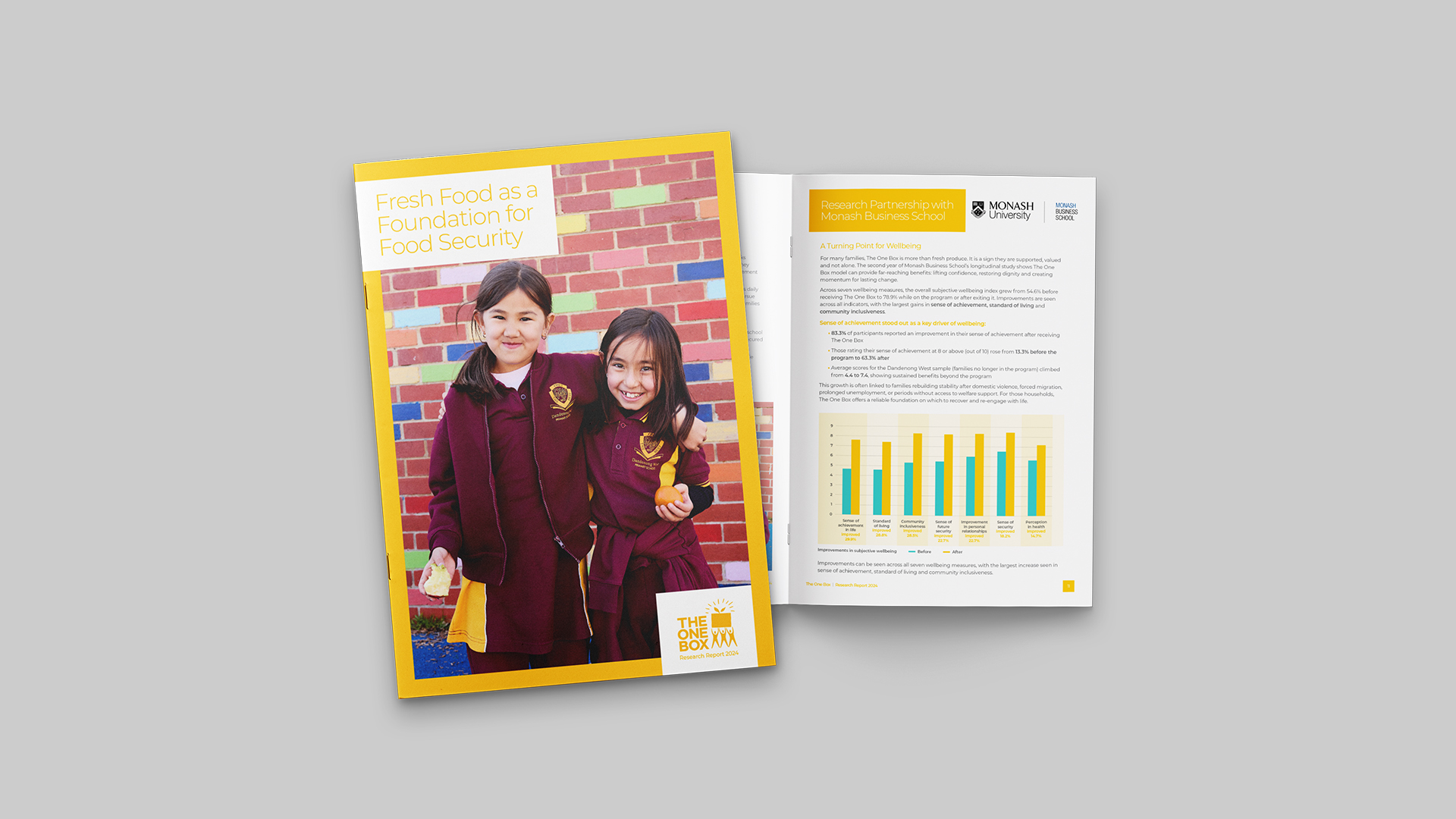
The One Box 2025 Impact Report, From Fresh Food Comes Lasting Change, marks the conclusion of a three-year study examining how consistent fresh food support influences families over time.
Across the three years of fieldwork, researchers conducted more than 130 interviews with families and School Program Coordinators. The research explored the connections between nutrition and wellbeing, financial savings, community connection and pathways towards greater independence.
The findings reinforce something families and school communities have experienced firsthand: consistent support can create the conditions for change that reaches far beyond food relief.
What Does The One Box 2025 Impact Report Show?
The 2025 Impact Report brings together three years of independent research and The One Box’s own program data to examine what happens when families can rely on regular access to fresh food delivered through a trusted community.
In 2025, The One Box supported approximately 2,500 families through 134+ school and community partners across Australia, delivering approximately 114,000 boxes of fresh fruit and vegetables.
But the impact of a weekly box isn’t measured by food alone. The research shows how consistent support can reduce financial pressure, strengthen connections between families and their school communities, create pathways to other services and help establish greater stability at home. The Business School’s Department of Accounting highlights how The One Box’s model provides lasting benefits beyond nutrition.
Key Findings From the 2025 Impact Report
Among the findings highlighted in the report:
- 54% of parents reported improvements in their children’s social and emotional skills
- 29% reported improvements in overall school wellbeing
- 22% reported improved confidence at school
- 38% of families surveyed connected to or tracked through referral pathways
Those referral pathways can connect families with support including housing, employment, financial and legal assistance, language and other community services. Taken together, the findings suggest that food support can serve as an entry point to something broader: stability, connection and opportunity.
Why Consistency Matters in Food Relief
Food relief can address an immediate need, but families experiencing financial pressure, isolation or uncertainty often need more than a one-off response.
Consistency changes the experience of support
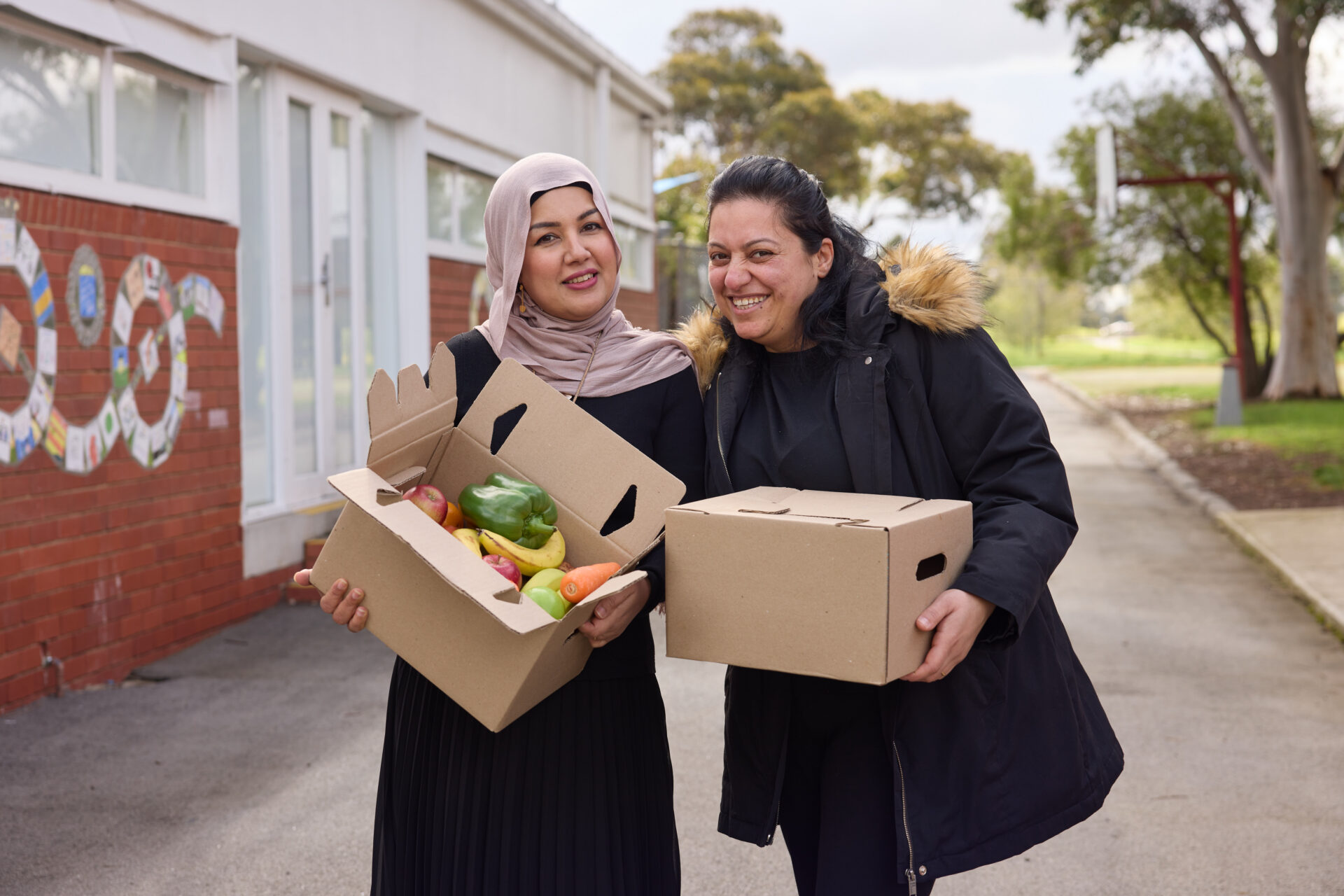
The One Box provides families with a box of fresh produce each week during the school year. Boxes are distributed discreetly through schools and community organisations families already attend.
There are no public queues and families don’t need to travel to an unfamiliar food relief service each week. Instead, fresh food is available through relationships within their local community where further opportunities present.
For families, knowing that fresh fruit and vegetables will be there again next week can remove one source of uncertainty.
As one beneficiary explained:
“I know it’s coming on Tuesday… I feel secure that day.”
That predictability matters. Across the three-year study, researchers found that reliable access to fresh food was associated with reduced day-to-day pressure and greater capacity for families to focus on other areas of life.
How Can Fresh Food Support Family Wellbeing?
Fresh Food Can Reduce Household Pressure
When household budgets are stretched, fresh food competes with rent, utilities, transport, medical costs, school expenses and other essentials.
The One Box gives participating families reliable access to fresh fruit and vegetables while freeing part of the household budget for other needs.
For one beneficiary, Sachini, those savings had a very practical effect:
“If I can save $50, that can go towards my bills and mortgage. That means less stress of finance. We are not panicking.”
Her experience captures one of the recurring themes across the research: the value of the box isn’t only what comes into the home. It’s also the financial and mental breathing room it can create.
Healthy Eating Becomes Visible and Familiar
Access also shapes habits.
School Program Coordinators observed that regular exposure to fresh produce helped families become more familiar with different fruit and vegetables, how to prepare them and how to incorporate them into everyday meals.
For children, healthy food also becomes something they can see, experience and talk about.
As one School Program Coordinator put it:
“The One Box plays a big role because you can actually see it. When you open the box, you see healthy food in it. It’s visible.”
The report describes families learning to prepare unfamiliar seasonal produce, children becoming curious about what is in their box and schools using fresh food as the starting point for practical conversations and activities.
What Does the Research Say About Children?
Year Three of the Monash Business School study placed children at the centre of the research for the first time, asking parents about changes in their children’s social and emotional development, school wellbeing and academic performance.
54% of parents reported improvements in their children’s social and emotional skills.
Parents most commonly observed improvements in areas including:
- consideration for others
- willingness to share
- ability to concentrate in class
- helping others
- following rules
- participation in class activities.
Parents also reported improvements in overall school wellbeing (29%) and confidence at school (22%).
Importantly, the research does not suggest that a box of fresh food alone determines a child’s academic outcomes.
Instead, parents described a broader chain of influence: reliable fresh food can help reduce pressure at home; reduced pressure can give parents more time and mental energy; and greater stability can create better conditions for children to learn, participate and engage at school.
Why Dignity Matters When Families Access Food Support
One of the clearest themes across all three years of research is dignity – something that sits at the heart of how The One Box supports families.
Families experiencing hardship don’t always seek help. Public queues, unfamiliar services, transport requirements, paperwork and the stigma associated with identifying as someone in need can all become barriers.
The One Box is designed differently allowing families to collect their box through a school or community setting they already attend. Support is discreet, and families can choose how much they engage.
As one School Program Coordinator explained:
“It is confidentiality. It is being discreet. It’s her dignity. Protecting that dignity.”
Over time, that approach can create something particularly valuable: trust.
How Does a Box of Fresh Food Open Pathways to Broader Support?
The weekly collection creates regular contact between families and School Program Coordinators.
At first, the conversation might simply be about the food in that week’s box. Over time, familiarity can grow into trust, and trust can make it easier for families to talk about other challenges.
Through these relationships, families have been connected with services and opportunities including:
- housing support
- Centrelink services
- legal assistance
- employment pathways
- language programs
- family violence services
- other community support services.
In 2025, 440 families surveyed were connected to or tracked through referral pathways, and 149 families reported a positive outcome following a referral.
These outcomes included securing stable housing, gaining employment, accessing mental health support, resolving legal matters and becoming eligible for government assistance.
The food is important. But in many cases, the relationship created around the food is what opens another door.
What Impact Continues After a Family Leaves The One Box?
Perhaps the most important question in a longitudinal study is what happens over time.
In the final year of the Monash research, researchers followed families who had voluntarily left The One Box to explore whether benefits experienced during participation had continued.
Their experiences provide insight into how routines, skills and relationships established during the program can continue after weekly food support ends.
Amina’s story is just one example.
When her son started school, her family was under significant financial pressure after moving into their own home. The weekly box provided immediate relief, but coming to the school every week also gradually connected Amina with other parents and the community hub.
Those relationships led her to a sewing class for women who had recently arrived in Australia. After three terms, she was offered a job as a community coordinator. After two years, her family no longer required food support.
Amina reflected, “After we stopped getting the box, it wasn’t hard anymore. We understood how to manage, how to save, and how to live on our own.”
Today, both Amina and her husband are in stable employment. Her experience demonstrates what lasting change can look like: not permanent dependence on food relief, but greater confidence, capability and connection.
Fresh Food Can Be the Beginning, Not the End
The One Box model starts with something simple: fresh fruit and vegetables, every week. Three years of research show why the way that food is provided matters:
- Fresh food delivered consistently helps relieve pressure
- Discreet distribution protects dignity
- Weekly contact builds trust
- Trust creates conversations
- And those conversations open pathways to broader support
That is why The One Box is more than a box.
It is a model designed to help families move from immediate food support towards greater stability, connection and independence.
The Need for Fresh Food Support Continues to Grow
The research demonstrates the potential of consistent, community-based support – but demand continues to exceed the program’s current reach.
Close to 100 schools remain on The One Box waitlist.
The infrastructure, supply chain and school partnerships to reach more families are already in place. What is needed is funding.
Through The Fruit Box Group’s national network, The One Box can leverage existing infrastructure, logistics and supply chains to direct more resources towards families.
Every new donor, corporate partner and philanthropic supporter creates the opportunity to reach another family waiting for consistent fresh food support.
What Can a Donation to The One Box Achieve?
The One Box is delivered across a 40-week school year:
- $600 per year supports one family throughout the school year
- $9,000 per year supports 15 families in one school community
- $45,000 per year supports 75 families across five connected schools
Every contribution helps turn fresh food into something larger: stability, dignity, connection and the opportunity to move forward.
Read The One Box 2025 Impact Report
From Fresh Food Comes Lasting Change brings together three years of independent research, measurable outcomes and the lived experiences of families to show just how far one box can go.
Explore the full 2025 Impact Report to discover what three years of research reveals about fresh food, family wellbeing, community connection and pathways to greater independence.
View The One Box 2025 Impact Report
If you or your business would like to support The One Box please get in touch.
